
All News
Advertisement

By taking advantage of the benefits provided by normal-phase mode, highly productive and cost-effective strategies for high-throughput purification of drug discovery products have been developed in the analytical laboratories at Lilly-Spain. The straightforward scaling-up of generic protocols from an analytical to a preparative scale has yielded successful results not only when working in HPLC but also when transferring conditions to other standard low and medium pressure chromatographic systems that are routinely used by synthetic chemists.
Advertisement
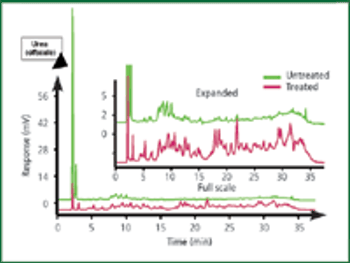
The micropipette tip containing solid phases is a relatively new sample preparation format that permits the handling of microlitre and submicrolitre amounts of liquid samples using the techniques of solid-phase extraction, dialysis and enzyme digestion. Phases are packed, embedded or coated on the walls of the pipette, permitting liquid samples to be moved and transferred without undue pressure drop or plugging. This column reviews the latest technologies in micropipette tip sample preparation used in the study of genomics, proteomics and metabolomics.
There are two types of contamination that will ruin a column - physical and chemical.
Advertisement
Advertisement

Dr Perdita Barran from the University of Edinburgh has won the coveted Desty Memorial Award for Innovation in Separation Science. Her work involved the use of ion mobile mass spectrometry (IM–MS) to analyse proteins and peptides and involved custom-building an ion mobility mass spectrometer. The findings of the research could be useful in helping to develop new classes of antibiotics and drugs to treat diseases of the reproductive system.

Size exclusion chromatography (SEC) coupled to light-scattering, viscometer and refractive index detectors is a common technique used for the characterization of polymers. In this article the solution conformations of two chimeric IgG3 antibodies were studied using this coupled triple detection technique. Conclusions indicate that the results allow hydrodynamic modelling of the antibody structures.
News All the news from November 2005 Opinion Safety versus Innovation: Zosimus reminisces on past chromatography innovators and wonders whether modern health and safety concerns are hampering today's scientists. Market Trends & Analysis Glenn Cudiamat reports on the laboratory information management system industry. Ultra fast gas chromatography: a viable solution for the separation of essential oil samples Riccardo Facchetti and Andrea Cadoppi Country focus The Column focuses on technology, events and companies making the news in Eastern Europe. Q&A Dr Perdita Barran talks to The Column about her work on ion mobility-mass spectrometry, which recently won her the 'Desty Memorial Award for innovation in Separation Science.' Supplies & services
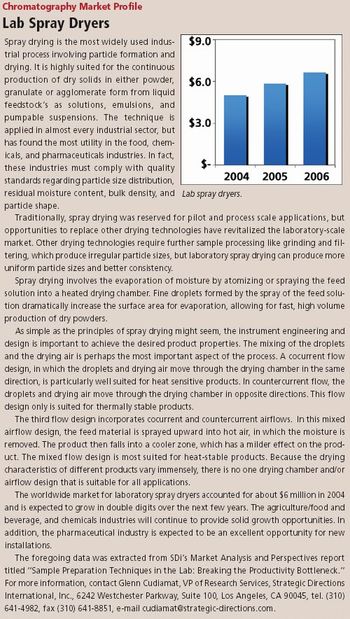

There is growing evidence that blueberries have powerful disease-fighting properties. Here the authors explore the research being done in this area, describing the use of a magnetic seector GC-MS SIM method to determine the presence of phenolic antioxidants in blueberries.

The Centers for Disease Control and Prevention (CDC) estimates that each year in the United States, 76 million people get sick, 325000 are hospitalized and 5000 die from food-related illnesses. Food-borne illness is a serious public health problem. -National Library for the Environment, Food Safety Issues in the 107th Congress, 2001, Donna U. Vogt.
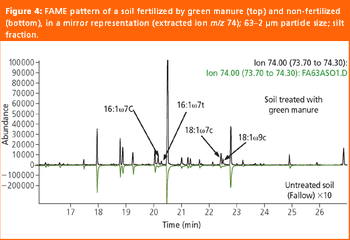
Conventional pyrolysis can cause defunctionalization of polar structural moieties carrying functional groups, which leads to biased results.
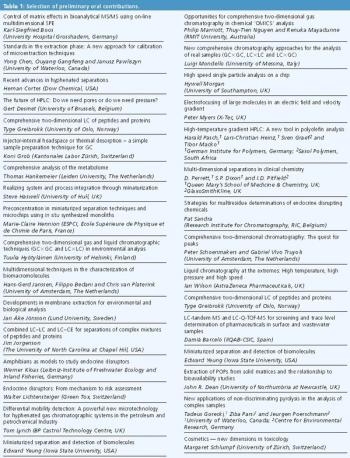
The Eighth International Symposium on Advances in Extraction Techniques (ExTech) highlights new extraction technologies for chemical and biochemical analysis in laboratory and on-site settings. Generally, the series focuses on solvent-free sample preparation including methods for rapid and selective enrichment prior to analysis and micro-sample preparation. Major emphasis will be placed on the fundamental understanding of extraction processes that result in greater selectivity and efficiency in method development and a rationalization of method selection for specific applications. On-site environmental methods and biomedical applications will be covered. The ExTech symposium series was initiated in 1999 by Professor Janusz Pawliszyn. The 2006 edition will focus especially on passive sampling methods, use of molecular imprinted polymers, biologically modified sorbents, novel coatings and sorbent material and will take place on 6–8 February at the Moat House Hotel, York.
Advertisement
Advertisement
Trending on LCGC International
1
Unlocking Discovery Data: Why a Digital Ecosystem Matters for HT-MS
2
Streamlined Method Development for Efficient and Reliable Lipid Nanoparticle Analysis
3
LCGC Blog: Rewiring the Fundamentals
4
Best of the Week: The Scientific Method in the Age of AI, Rewiring the Fundamentals
5
